My video testimonial of Srivalli's blog and expertise!
Support Srivalli by buying her E-book!
Read my review!
Flavours from South Indian Kitchen:

Visit Srivalli's blog: Cooking 4 All Seasons.
My video testimonial of Srivalli's blog and expertise!
Nithya always has something interesting to share.
Here is a nice recipe for fenugreek sprouted pancakes (dosa).
Check the recipe by clicking here.
I can't wait to try it.
By luckyfatima
Pakistan is roughly the same size as France or Texas, and has a wider variety of available cuisines than an outsider may ever have imagined. I love to learn about food and culture and wanted to share with you a few interesting aspects of Pakistani cuisine based on regional features of the country that few may know about.
Is Noodle Soup a Pakistani Food?
In parts of Pakistan, the languages are actually related to Tibetan (some are mutually intelligible with Ladhakhi). Noodle soups are eaten there. You can google 'Hunza dodo' to see the way this soup is prepared in the region of Hunza, for example. Also, you can look into the cuisine of Baltistan if you are interested.
Is There South Indian Food in Pakistan?
People of South Indian origin reside in Pakistan. Besides the large amount of Hyderabad Indian origin people in Karachi, there are other people whose families are originally from various parts of South India. Almost all of these people will be found in Karachi. There is a neighborhood in Nazimabad, Karachi called 'Madrasi Colony.' It is just a center where some Tamils settled after partition. The majority ethnicity in Pakistan is Punjabi. Pakistan is very diverse, and in each province, there are distinct indigenous communities. In major urban centers, there are many people whose families came from India at Partition, and one can find many of the same diverse groups that are in India, Marathis, Konkanis, Burmese-Gujaratis, Biharis, Bhopalis, U.P. origin people, and so on…their family heritage adds distinct particularities to their food preferences and home cooking styles.
Is There Pakistani Vegetarian Food?
Though non-vegetarian food is what comes to mind when someone mentions Pakistani food, there are a range of vegetarian options including karhi pakora, lauki daal, mungori, and many other dishes that would be shared with Northern and North Western India. North Indian vegetables can also be found in Pakistani markets, including karela, lauki, arvi, turai, tinda, kaddu, all the greens, among others. All of the typical North Indian vegetable dishes are consumed in Pakistan.
What is a Traditional Pakistani Meal?
A "proper" full meal will have a meat dish (or two), one or two sabzis, daal, pickles, fresh sliced vegetables, rice, and roti or some other flat bread. What people will be eating specifically will depend on region, the season, and so on. Poorer people (the majority of people) often eat vegetarian, not due to religious reasons but only economic constraints. Villagers in Pakistan would be eating the same plain rice, daal, salt, onions, and green chiles as villagers in North India.
Conclusions
The iconic dishes of Pakistan are mainly meaty. But what is "Pakistani cuisine"? There is no such thing. Just like there is no such thing as "Indian cuisine" in any real sense. Like, the foods of Indian Punjab are not like the foods of Tamil Nadu. And within Tamil Nadu, the foods of Chennai are distinct; the foods of Iyers are different from the foods of Chettiyaar communities, different from Iyengars, different near the Kerala border, different for the multiple distinct communities of Muslims, and so on. Because of this it is hard to pin down "Pakistani food."
With all that being said, I have tried my best to share with you some of the lesser known aspects of Pakistani food and culture. I am happy to learn more by reading your insightful comments posted on this blog.
Thank you for reading.
===article concluded===
See luckyfatima’s blog. Click here.
Next month, I will be teaching a series of classes on Indian cuisine in Rochester, NY. You can see the list of classes here. In the meantime, if you're interested, you can see this video I made from a class I gave earlier this year on South Indian Cooking. In this video I show how I prepared for the class- all the cooking gadgets, utensils, pots and pans I required to manage the class along with the food items and tips and tricks for giving Indian cooking classes and cooking Indian food. Enjoy!
Tips on Teaching and Cooking South Indian Food (Idli/Dosa/Chutney) from Authentic Journeys on Vimeo.
Food and Recipes
Dhal or Lentil Dishes
Aayi's Recipes - Chana Dal Soup (Poli Saru/Holige Saru)
Idli Varieties
**Idli is a breakfast food or snack made of steamed ingredients formed into something that looks like a muffin top. ;-) It's usually eaten with chutney or sambar.
Sailaja Kitchen - Yellow Corn Meal Idly
Veggie Platter - Brown Rice Ragi Idli
My idli/dosa recipe photologue.
Relishes and Side Dishes
4th Sense Cooking - Marinated Chillies / Moar Milagai 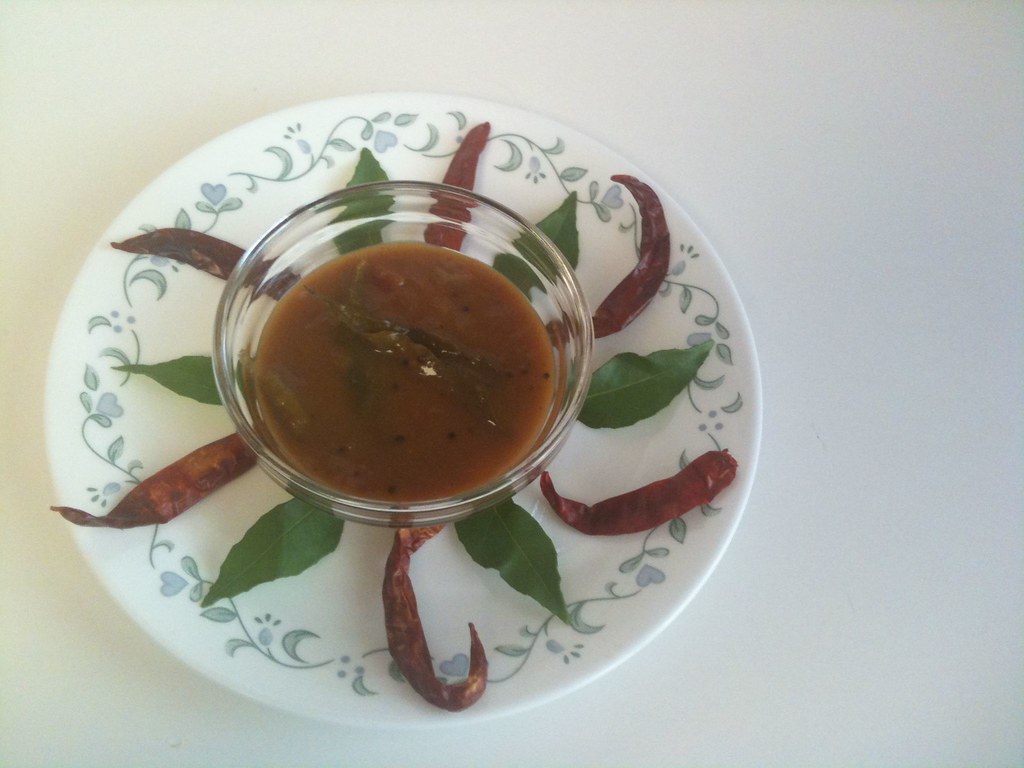
Sailu's Kitchen - Coriander Roasted Dal Chutney
Veggie Platter - Onion Gojju / Erragadda Pachipulusu (Photo of this, right, from my kitchen!)
Snacks
Edible Garden - Bread Paneer Rolls - Step by Step Recipe
Culture of Food- Commentary
Slices of Kerala Life - Eating out – a date with death?
As the culture of going out to eat in 'hotels' is on the rise, people must be aware of the risks of eating out.
Recipe Review Archives
Scheduled
*See the Brighton Continuing Education Brochure for details when ready.
Masala Madness (title to be changed)
Have you ever wondered what comprises the garam masala, sambar powder or rasam powder that spices your dhals, curries, stews and soups at Indian restaurants? Do you want to learn how to make your own fresh made all-spices mixes inspired by the authentic family traditions of India? These easy to make powders can be used to make specific ethnic North or South Indian dishes or to Indianize your American dishes just begging for another layer of taste temptation! We will make spice mixes and have a few dishes to taste with the mixes cooked in! Bring a plastic container for any leftovers. (Materials fee of $20 paid to the instructor at the first class)
India- Inspired Gluten-Free Pancakes
Gluten-free diets are on the rise. Luckily for people interested in trying new kinds of foods; the cuisines of India offers opportunities to eat many different kinds of gluten-free, protein- packed pancakes and crepes made with rice and lentil (dhal) flours. In this class, you will learn how to make the “besan ka cheela” or chick pea crepe/ eggless- omelets, a mixed lentil and rice crepe known as an “adai” and the “pesarattu” or moong-bean crepe. (Materials fee of $10 paid to instructor at first class)
Dining Out - Cuisine of India
Many of us have our staple menu choices at any restaurant, but maybe more so at our favorite ethnic Restaurants. Have you strayed from your staple choices at the Indian restaurant? Maybe you have yet to try food of the Indian subcontinent because you don’t really understand the names of the dishes. Sure, menu writers translate the dishes into English, but sometimes that may not be enough. Have you wondered if the name of the dish refers to the ingredients in the dish, a preparation style or something else?
Let’s dissect menu options from various local restaurants to learn a little more about India, Indian cuisine and Indian culture!
Flexible Offerings
These classes can be given at any time in the Rochester (Monroe County, Wayne County, Ontario County, Orleans County). More details Here.
Classes with cooking demos are $50 per student
Classes without cooking demos are $30 per student
Special Promo- If you find four friends (total with you, 5), you can choose one of two discounts-
Promo 1. With each four students you recruit, $5 is off individual tuitions (5 students, each gets $5, 10 students, each gets $10 off. If you get the cap of $12 for a cooking class, each of you can get $12 off!)
Promo 2. Travel fee of up to $25 can be waived (regardless of number of students, even if 1 student or 10 students)
More about travel fees here.
Cultural Classes
*Classes without cooking and spice demos are $35 per student
Cooking Classes with Demos
*Classes with cooking and spice demos are $50 per student
India- Inspired Gluten-Free Pancakes
Gluten-free diets are on the rise. Luckily for people interested in trying new kinds of foods; the cuisines of India offers opportunities to eat many different kinds of gluten-free, protein- packed pancakes and crepes made with rice and lentil (dhal) flours. In this class, you will learn how to make the “besan ka cheela” or chick pea crepe/ eggless- omelets, a mixed lentil and rice crepe known as an “adai” and the “pesarattu” or moong-bean crepe. (2.5 hr)
Mystery of Indian Cuisine – Demystified!
Have you savored the multi-layered flavors in Indian cuisine and wondered how to accomplish this yourself? Indian cooking is flavorful, but it doesn’t have to be hot. I will demo a full meal of three menu items. Students can have the opportunity to try their hand at cooking also. Students can bring an apron and empty containers to take home any leftovers. (2.5 hr)
Masala Madness (title to be changed)
Have you ever wondered what comprises the garam masala, sambar powder or rasam powder that spices your dhals, curries, stews and soups at Indian restaurants? Do you want to learn how to make your own fresh made all-spices mixes inspired by the authentic family traditions of India? These easy to make powders can be used to make specific ethnic North or South Indian dishes or to Indianize your American dishes just begging for another layer of taste temptation! We will make spice mixes and have a few dishes to taste with the mixes cooked in! Bring a plastic container for any leftovers. (2.5 hr)
The Seduction of Spice
Recently, the healing powers of turmeric, a main ingredient in an Indian spice cupboard has gained notoriety. Turmeric, along with the aromatic and healing powers of a wide variety of other spices, lentils, rices and flours creates an unforgettable layered sensory experience in any Indian dish. Come to this multi-sensory workshop to experience a wide range of ingredients: their uses and noted health benefits. (2.5 hr)
Some yummy recipes I found on blogs the past month- Enjoy!
 I have never had a homemade version of this dish.
However, this product seems to be well made. I used the oven warming instructions. It warmed evenly. It has a full, flavorful taste. It is not hot spicy immediately, it kind of builds. If you eat mildly spicy, like I do, the hotness will build on you. Else, if you eat hot and spicy, this may be mild. I ate one helping (there are about 1.5 helpings) of this with rice, then a second helping of rice with plain yogurt.
I really like how it has small eggplant pieces in the gravy. I prefer the pieces to the pureed eggplant. I know the pureed one is called Bhaighan Bharatha. Does Baghara mean whole pieces of Baingan (eggplant)?
Price is 4.79$ at our local India Market. Seems a bit high, but the taste is quite nice for a ready made convenience food, I can justify the price. I rarely make eggplant dishes at home because hubby doesn't like eggplant, so to make for one person, and the time involved, I will buy this readymade version again sometime.
Anyone else tried this or any other brand of this? What did you think? Any comparisons to homemade versions?
Thanks for reading!
Easy Salsa Recipe- With a Twist
This is a chunky salsa good for dipping chips or adding as a topping to dish of your creative desire.
¼ cup finely diced onions
¾ cup diced, juicy tomatoes
¼ cup diced red bell peppers (capsicum)
3 tablespoons diced fresh cilantro (coriander) leaves
1/4 cup cooked corn kernels
Dash salt
Lemon juice
Optional Green Chilies or Jalapeno peppers as per taste (finely sliced/diced)
Method:
EASY! Chop all ingredients and put in a bowl and mix nicely. Add only a dash of salt to bring out the juices in the vegetables. Add lemon juice as per your taste for tanginess. I used about 1 tablespoon.
Let this set for about 5-10 minutes before eating to allow tastes to blend. The fresher the vegetables the better the final product tastes (and smells!).
Corn is purely optional and the 'twist' I added for an extra layer of texture. Some people like to roast the corn then put it in to give another layer of taste. I did not roast the corn.
**This dish is eaten raw. The only item in this dish that is cooked is the corn- but that is separately done. This dish is best eaten cold or slightly cooler than room temperature.
**For my desi friends, I have tagged this post with the term 'chutney', I think salsa is the 'Mexican chutney'! It is a great relish or dip.
***********************************************************************************
A friend shares:
"For a different twist on the same recipe you can also cook the above ingredients for about 5 minutes on the stove top. Mix in a blender for a cooked salsa. Also good with carrots, jicama, and /or cabbage. I often throw in what is around in the fridge."
Review of Viji Varadarajan's and Padmini Natarajan's Classic Tamil Brahmin Cuisine
Jennifer Kumar
None of that westernized Indian food here! Viji Varadarajan and Padmini Natarajan recently released an updated version of their cookbook Classic Tamil Brahmin Cuisine: Pure Vegetarian South Indian Samayal.
With over 70 mouthwatering vegetarian dishes, having this book is a good place to start learning more about how Indian food gets its flavor. Of course, this ‘Tamil Brahmin’ cuisine is a specialized, regional cuisine from South India, and may be new to many Indian food lovers who are used to the rich butter, nut, tomato and other gravy-based dishes of North India. This cuisine offers a different approach to Indian food, with unique combinations of spices such as cumin, coriander, mustard seed, chili pepper, red and green chili, black pepper, curry leaves, fenugreek (methi), turmeric, ginger, and a host of lentils. Yes, it is true that lentils, known as dhals in Indian cookery and cuisine, become a spice! Lentils can be dry roasted and ground in with spices to make all-spice powders like sambar powder or pitlai powder, or roasted in hot oil to temper sambars (stews), rasams (soups) and chutneys (relishes, dips).
In some sections, the vegetables such as banana flower, banana stem or [fresh] jackfruit or drumstick can be a challenge to find in America, while most others can be found in typical American grocery stores (beans, eggplant, okra, spinach) or a trip to your closest Indian or Asian grocery store (bitter gourd and other gourds, and other types of beans). It is indeed amazing that over 70 dishes can be made from the small variety of vegetables and roughly 30 spice combinations. This may also seem overwhelming to a newcomer of this cuisine and culinary method, but upon closer inspection it is noted that about 7 broad categories – kari (11), kozhumbu (7), kootu (10), pachadi (5), sambar (6), and usili (4) of recipes comprise about 40 individual selections in the book! When looking at the book from this angle, South Indian Tamil Brahmin cookery can become even easier. Many recipes that fall under the same category have roughly the same method, minus the main vegetable highlighted. Once the method of “kari” or “kootu” is studied, for instance, a simple substitution of a vegetable may change the dish, but the method to get to it changes only slightly. In some such cases, with a touch of creativity and adventure, a substitution of other vegetables can be used – such as a squash for kootu, or potatoes for kari, or onions for sambar or kozhumbu (onions are traditionally not used in Tamil Brahmin food).
Many may still feel intimidated by Indian cookery because recipes may feel long or have many steps. When I learn a new recipe I try to have all the ingredients prepared before I start cooking and do each step slowly and complete each step before I go to the next. When I get more experienced at a recipe or method, I then can layer my approach to preparation and cooking- just like Indian food! The layering of flavors, blending of tastes, textures and aromas make Indian food- and particularly Tamil Brahmin food a unique draw. Once you try this cuisine, you will want more. You will crave it for the layers of taste, flavors, aromas and textures- and of course all the better that it’s totally made from scratch – no artificial flavors, colors, preservatives or ingredients you ‘can’t pronounce’ (or understand), because you have handled them all!
Like the layering approach to getting the tasty Tamil Brahmin dish, the cookbook also has its intriguing layers that draw me back into its pages again and again. This book comes in handy not only in the kitchen- but in the grocery store. I don’t know about you, but I often get intimidated when I am to go purchase fresh vegetables, regardless of if they are ones I have purchased before (such as bitter gourd or okra), or ones I have yet to buy (such as ash gourd or broad beans). Sometimes my fear for getting the freshest one stops me from buying at all because I fear I will pick up the rotten one. This book helps me to overcome this fear. It has detailed some strategies for choosing the freshest harvested vegetables and storing them. For instance, I never realized an easy way to remove leaves from drumstick branch is to wrap it in newspaper overnight, and let them fall off naturally the next day or that the shelf life of Indian pumpkin was so long! Furthermore, she shares some unique cultural and historical trivia about certain vegetables like snake gourd, and how it was grown to look like a snake! In addition to these tips, at the end of most recipes look for tips on recipe adjustments or where microwave can be used to speed up some processes.
This book is both a treasure and a staple in my cookbook collection. I recommend it to anyone who enjoys cooking ethnic foods or simply learning about culinary traditions and unique cultures. I am sure the folks at Gourmand also agree, having had awarded this one-of-a-kind gem the prestigious jury award in 2009.
Cookbooks of Viji Varadarajan:

.JPG)


