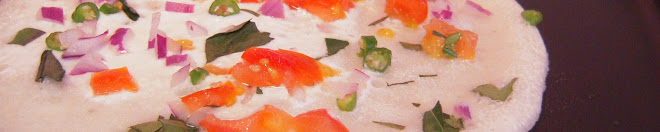
This chickpea based recipe is a vegan alternative to an egg-based breakfast.
Although I have been making this breakfast alternative for the past few years, I never got it quite right. The main problem I continued to have was the ratio of water to besan flour. Today, as I made it again, I thought carefully about this and how to approach it. I decided to take more careful measurements. The end result has surprised me! I realised the ratio of besan exceeds water! Though I must have done this in the past, I was not conscious of it, and never really made the recipe with this in mind. The ratio of besan to water I used it 3:2 (in this case 1 measure equals 1/4 cup- so 3/4 cup besan, 1/2 cup water). This may make a thicker batter, and heavier pancake. Other sites say 1/2:1 ratio or 1/2 cup besan to 1 cup water. Try both ways and see what you like better. I have a problem cooking the thinner version, when it's too watery. I will have to improve myself!
As I did a little Internet research on this recipe, I found that it is also called 'cheela', though I am not sure what language this is. Cheelas, like western pancakes come in many varities, like besan, moong dhal (which I have made), oats (which I have yet to make), and others I do not yet know. Links for these will be at the end of the post.
Ingredients:
3/4 cup besan (chick pea flour)
1/2 cup water
1/4 tsp salt
1/4 tsp cumin seeds
1/4 tsp red chili pepper
1/4 tsp (heaping) ginger paste
1/8 cup finely chopped onion
1-2 green chilies, the small Indian kind
pinch of green herb like dried fenugreek, finely chopped cilantro (coriander leaves), parsley, etc. for color
Method:
1. Place besan flour and water in a blender and blend out any lumps. The mixture should be a little thinner than pudding. It should not be watery or it won't cook nicely. This could vary slightly on the quality of besan.
2. Transfer to a bowl, add salt, cumin seeds, red chili powder, ginger paste, green chilies, onions and green herb.
Note about chilis: It is ok to reduce or leave out if you don't like hot spices, the other spices will give flavor. For green chilies if you can't find Indian kind, use what you like but it will give a different taste. I finely slice the green chili, adding the chili and seeds into the batter. I gauge the amount by the number of slices, usually 8-10. Sometimes one chili is enough, sometimes two are required. You can add more if you like it hotter!
3. Heat a pan and put oil on it. Heat pan on high. When it is really hot, reduce heat to 3/4, take the pan off the flame and place half the batter on the pan and even it out. Fry on flame two minutes and flip. Flip a few times until you get a golden brown color. The pancake may appear soft and not done all the way through. Sometimes if you let it set for a few minutes after cooking to cool it, it will set itself when the ratio of water to besan is correct.
Alternative: For a green feel and another texture, others add peas. I have not tried this, though it seems interesting. Here's a recipe, green peas cheela.
This makes two servings, two pancakes. Besan pancakes are filling, and can be heavy.
Eat with a side of your favorite sauce (ketchup, salsa, green chili sauce), sour cream or cream cheese.
Thank you for reading my blog.
Related posts/sites
Throw away the recipe; Learn the ratio instead (NPR)
My old besan pancake recipe
Tuesday, August 4, 2009
Besan Omelette

Saturday, July 19, 2008
Quinoa Upma
By: Jennifer Kumar
More comments on Facebook
Ingredients:
1/2 cup uncooked quinoa
2 tspn oil (vegetable or olive)
pinch mustard seeds
8-10 curry leaves
2-3 green chilies sliced in half lengthwise
1/8 cup finely diced onion
15-20 cashew pieces as per taste (optional)
1/8 cup each -corn kernels, peas, edamame
to taste salt
Method:
1. Heat oil in a wok.
2. Add mustard seeds.
3. When seeds pop add curry leaves, green chilies, onions and cashews. Stir until onions become translucent or cashews brown.
4. Add 1/2 cup water and add in veggies. I used frozen vegetables so I steamed them in this mixture until soft.
5. Add quinoa and 1 cup water. (Quinoa is cooked with twice the water as quinoa, but the extra water already added softened the veggies and cashews.)
6. Add salt to taste and keep stirring and cooking. Quinoa grains separate after cooking for some time, this means they have been cooked. Keep cooking and stirring until water has evaporated. Upma should be a dry stir fry mixture. Do not leave mixture alone, it should not burn and could easily burn if not watched and stirred continuously.
Serves 3-5.
Upma is the name of a variety of dishes with a similar consistency. Salt or uppa is the main ingredient. From our most educated guess upma comes from combining the (Tamil/Malayalam) words uppa (salt) and maavu (batter/mixture). There are different varieties of upma, and by the title of upma you know the main ingredient. In this case, it is quinoa. I have made the most famous upma with sooji (rava), in addition to vermicelli, bread and Buggani (Puffed Rice Upma). The other varieties are very similar except in how to prepare the main ingredient for the upma. I am sure there are other varieties, but I have yet to be introduced to them!
Notes on Quinoa: "Quinoa was of great nutritional importance in pre-Columbian Andean civilizations, being secondary only to the potato, and followed in third place by maize. In contemporary times this crop has come to be highly appreciated for its nutritional value, as its protein content is very high (12%–18%), making it a healthy choice for vegetarians and vegans." (source: Wikipedia)
More comments on Facebook
tags: quinoa, grains, upma, "upma varities", breakfast, "Indian breakfast", "south Indian breakfast"

Wednesday, June 11, 2008
Chiratta Puttu with Kadala

I have tried and tried many a time to make puttu (steamed rice powder with coconut gratings) and kadala over the years in our 'trusty' puttu kutty. (See what I am talking about here.)
In fact for the puttu it was a faulty puttu kutty- nothing could cover the gaps where steam was being released... But as for the kadala curry, it has to be a user error! I had not left it in the pressure cooker long enough and like with things that take too much time, I probably just missed it by a little time due to impatience.
So, now instead of that puttu kutty maker, I have a chirattu (I think that is what it is called). This is a small steel bowl with a loose fitting metal top that goes on top of the pressure cooker where the weight goes. This is meant to be a reusable replica of a coconut shell. Practically, this is able to be flown out of Kerala on a plane, unlike the coconut shell!
In my search for a photo of the puttu kutty, I found a post on making puttu in a 'homemade' steam contraption. This innovative approach by inji pennu makes puttu making fun and easy for anyone (especially in America) who has access to only local products and not Malayalee cooking utensils. See Inji Pennu's blog here.
This time, I vowed I'd be patient from the moment I began soaking the brown kadalas (chick peas) to the very end of steaming the puttu - and the result was very nice.
I have adapted this recipe from Annita's website and from recent cookery lessons on our trip to Kerala!
Kadala Curry
Ingredients:
1 cup dried brown chickpeas (known as kadala)
1 cup coarsely chopped onions (I used red onion)
1 cup coarsely chopped tomatoes
2 green chilies sliced lengthwise but not fully chopped in half
1/2 tsp ginger paste (or alternatively you can use a few chunks of fresh ginger)
1/2 tsp garlic paste (or alternatively you can use a few cloves of crushed garlic)
pinch cumin seeds
1/2 tsp red chili powder
1 tsp coriander powder
1/8 tsp turmeric
pinch ing (optional)
salt to taste
1/4 cup grated coconut
4 tbspn Olive or Vegetable oil (I used olive oil)
10 curry leaves
pinch mustard seeds
Method:
1. Soak the kadala beans overnight. This time I actually soaked them until few beans broke open and revealed their white inner core.
2. When kadala has soaked properly, take a pressure cooker and put it on high flame.
3. Add 3 tbspn oil oil. Temper the cumin in this oil a few minutes when it becomes hot.
4. Turn down the heat to medium and add the onions. They should 'sweat'. I did not fry till brown.
5. After about 5 minutes, add the tomatoes and green chilies and stir.
6. Add the ginger, garlic, turmeric, red chili and coriander powder and stir.
7. After the contents of the pan have been sufficiently covered with the spices, add the kadala beans. Add three times the water as the measured soaked beans*, ing and salt to taste. (I did not measure the salt, I poured it in, but it's better to add less salt and more can be added later.)
8. Turn up the heat to high, put the top on the pressure cooker along with the weight. Pressure cook for about 4-5 whistles. (I was told to do 4-5 whistles, but my whistler is broken I guess as it went off only twice in the span of an hour and a half, so it basically boiled a long time. So at this time I took off the lid and tasted it. You know it's done when the beans are medium soft. The beans should not be so soft they can be mashed. Slightly hard is best - it's at least what we like!)
9. When this part is done, take 1/2 tspn oil and heat it on a frying pan. Add the coconut gratings and brown them. Set them on a plate to cool.
10. In that same skillet after cleaning out the coconut pieces, heat 1/2 tspn oil and add mustard seeds. When they pop, add the curry leaves. Fry about a minute. Add to kadala pan. Take a ladle or two of the kadala water, put it in the skillet and pour it back into the kadala pan. This actually helps you to collect all the tempered oil taste of mustard seeds and curry leaves.
11. When coconut has cooled, put it in a blender along with two ladles of the kadala (take whatever the ladle has in it- kadala, water, onions, tomatoes, etc.) and blend it so that the coconut pieces become pureed in this. Add it back to the kadala pan.
12. Reheat this kadala to be eaten with the puttu.
Puttu
Ingredients:
2 cups roasted rice flour (you can buy this ready made at the Indian store, called puttu powder or puttu podi)
1/4-3/4 cup water
pinch salt
1 cup coconut gratings
Method:
1. Before making the batter, fill a pressure cooker 3/4 with water. Put on the top, but do not put the weight on. When steam starts to come out of the top, you can put the chirattu on it.
2. The trick to making good puttu is mixing the puttu flour with the water. Put all the puttu podi in a bowl.
3. Measure the water, mix the salt into it.
4. Mix all this with your hand. Little by little with your left hand pour few drops of water into your right hand. Mix it into the puttu podi. By 1/2 a cup of water the flour will start to get lumps in it. Sometimes depending on the brand of puttu podi, this may be enough water. With the brand I used I had to go to 3/4 cup water adding little by little and mixing with hand. The final product will be lumpy but not doughy. If you put the puttu mix in your hand and make a fist it will stick together but it will not be wet. It will be dry and it will crumble apart. This is what you want. It may be hard to get this done using a spoon. It's better to use your hands.
5. In your chirattu puttu (pictured above) put a layer of coconut gratings to cover the hole in the bottom that will let steam in. Then add the puttu podi you have prepared. Put the top on the chirattu puttu and put it on the pressure cooker where the weight was.
6. Once steam starts coming out of the top of the chirattu puttu, wait 6-8 minutes. Remove and it should be able to be tipped upside down onto a plate to give you a bowl like shape. It should not fall apart.
Eat with the kadala curry on the side.
Some like to break up the puttu cake and add sugar or jaggery on it. Jaggery can also be added into the puttu podi while steaming it. Add as per your own taste.
In case you don't have kadala curry but still want to eat the puttu, put it on your plate, crush it, add ghee (clarified butter, or melted butter), sugar or jaggery per taste and bananas (optional).
This is a typical breakfast in Kerala, India. The puttu eaten with sugar and banana can be called common man's food as it is easy to make and not many ingredients is needed to make it.
*Once the beans soak they get a little bigger. Put them in the measuring cup and see how much it is and add three times this amount of water. You can add twice the amount of water also for less watery gravy. I like to put more water to get this 'kadala water' that can be added to plain rice and is very tasty!
Nice video showing the use of coconut shell!
** Chirattu Puttu is a famous breakfast dish in Kerala (South west India). It is steamed rice powder with coconut and salt. Generally puttu is taken with kadala is a savory dish. However, if no kadala is available, one can eat the puttu with butter/ghee and sugar and banana if desired. This is like a Kerala 'corn flakes' without milk!
**Kadala is a stew made from "black chenna" or black chickpeas, also known as kadala. This dish is famous in Kerala. Generally these two items are taken together. However, Kadala can be eaten with rice.
Sunday, January 13, 2008
Aloo (Potato Curry)
This dish, eaten for breakfast, is eaten with poori- a deep fried puffy bread.
Ingredients:
3 tbspn oil
pinch mustard seeds
1/4 cup diced onions
10 curry leaves
3-4 green chilies cut in half (add as many as per taste)
1 cup water
2 tbspn chenna dhal
2 cups cubed potatoes about 1/2 inch cubes, doesn't have to be uniform
1/4 tsp turmeric powder (haldi)
salt per taste
3 chunks ginger (about 1/8 inch chunks)
Method:
1. Heat oil in pan with mustard seeds.
2. When seeds pop add the diced onions on medium heat. Add curry leaves and green chilies. Sweat onions, do not brown or burn.
3. Add 2 cups water and chenna dhal with potatoes.
4. Add turmeric, salt, and ginger pieces. Boil until potatoes are fully cooked and can be mashed.
When it is done, potatoes will become mushy and pasty. It can be considered like a thick gravy. Not all potatoes should be mashed. You will be able to see potato chunks.
Variation 1:
Do not add mustard seeds, curry leaves or onions, instead temper 1/2 cup finely diced tomatoes in step 2. All other steps remain the same. This version can be eaten with pooris.
Variation 2:
Do not add mustard seeds, curry leaves or turmeric. Instead of boiling in water, boil in 1/2 water 1/2 milk. (This variety is more or less the Kerala potato stew.) This version is known to be eaten with appams or iddiappams.